

The global software development market is expected to reach $858 billion by 2027. It is growing at 11.7% per year, mainly because of AI adoption, edge computing, and digital transformation across industries. In this fast-moving market, picking the right software development services partner is one of the most important decisions a business can make.
Around 70% of enterprises now outsource software developm
ent to cut costs by 30 to 50%. This means there are hundreds of agencies to choose from. CTOs, engineering leads, and founders often find it hard to separate the good vendors from the average ones. Many agencies claim to be experts in AI, cloud, and mobile development, but only a few can actually deliver at the enterprise level with the right security, compliance, and communication standards.
This guide gives you a clear, step-by-step framework to hire a software development company the right way. It covers everything from writing your requirements to running RFPs, testing vendors with paid pilots, and signing contracts that protect you. Each section helps you avoid costly mistakes and find a partner who will treat your project with the care it deserves.
1. Define Your Project Requirements Before You Search
One of the biggest reasons software outsourcing fails is that companies start talking to vendors before they have clear internal requirements. According to Standish Group research, scope creep affects 52% of software projects and adds an average of 27% to total cost. The best way to prevent this is to finish your requirements document before your first vendor call.
What to Document Upfront
- What specific result should this software deliver? It could be more revenue, lower operating costs, better customer retention, or meeting a compliance requirement. Business objective:
- List the core features, third-party integrations, APIs, and infrastructure needs. Mention if you prefer a specific cloud provider or need on-premise hosting. Technical scope:
- Enterprise software development services typically cost between $50,000 and $500,000 depending on the project size. Set a realistic range instead of one fixed number. Budget range:
- Simple MVPs usually take 3 to 6 months. Full enterprise platforms with complex integrations can take 9 to 18 months. Timeline:
- If you have an existing tech stack like a legacy Java backend, mention it. If the vendor can choose the best tools for 2026, say that too. Technology preferences:
- Mention how many users the platform needs to support and what uptime level you expect, such as 99.9% availability. Scale targets:
- Be specific about what success looks like. For example, 30% faster time to market, 15% higher conversion rate, or $200K saved on infrastructure annually. Success metrics:
Pro Tip: Include your requirements document when you first reach out to vendors. Firms that ask smart clarifying questions instead of sending generic pitch decks show the kind of thinking you want in a long-term partner.
2. Evaluate Technical Expertise and 2026 Stack Alignment
The technology decisions you make in 2026 will affect your platform for the next 5 to 7 years. A vendor who is very good with older frameworks but has little knowledge of modern cloud-native or AI-ready architecture will create technical problems for you from the start.
2026 Technology Stack Reference
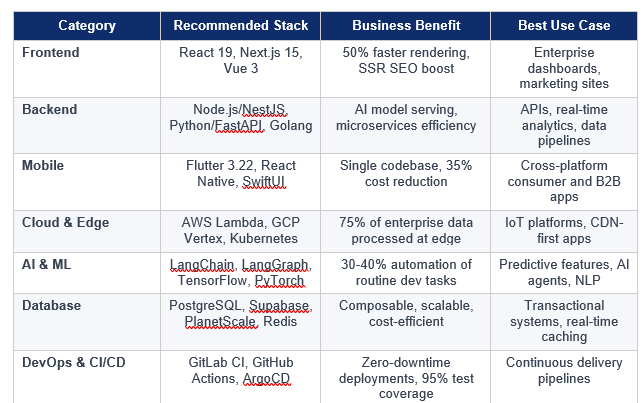
When you evaluate vendors, ask for live product demos instead of slide presentations. Request access to GitHub repositories with real commit history, architecture notes, and test coverage reports. For enterprise software development services, check that the team has a DevSecOps pipeline with automated security scanning built into the CI/CD process, not added later as an extra step.
Agencies that claim to be good at everything, such as fintech, healthcare, e-commerce, and logistics, rarely do any of them very well. IEEE research shows that domain specialists reduce project risk by 50% compared to general agencies. This is because they already have compliance frameworks, proven architecture patterns, and relevant integrations ready for your industry.
3. Assess Portfolio Depth and Verifiable Business Outcomes
Any vendor can put together a good-looking case study page. Your job is to look past the marketing and find real proof. When you hire a software development company, the portfolio review should show not just what they built, but what business result that software actually produced.
Portfolio Evaluation Criteria
- Look for at least five live projects in your specific industry delivered in the last two years. Concept projects and internal tools do not count. Domain relevance:
- Ask for real numbers such as 3x user growth after launch, $2 million in revenue linked to the platform, or 40% less customer support volume. Outcome metrics:
- Do not accept Figma prototypes as proof of delivery. Every portfolio project should have a live URL or a verified Clutch or GoodFirms review. Live production links:
- Firms with 80% or more repeat business from existing clients are usually genuinely good. High client turnover often means delivery problems that a polished sales pitch hides. Client retention:
If a vendor is still using 2022 stacks in 2026, they have not kept up with the market. Look for evidence of recent AI integration, edge computing projects, or serverless migrations. Technology recency:
For GCC market projects in Dubai, Ajman, or Qatar, focus on firms with real experience handling local data sovereignty rules, Arabic language support, and Middle East payment gateway integrations. Firms based in smaller cities like Ajman or Muscat often cost 20 to 25% less than Dubai-based firms while delivering the same level of quality.
4. Investigate Team Quality, Composition, and Delivery Processes
The team working on your project matters more than the name of the company you hire. Many software development companies win deals by showing senior architects during the sales process and then switch to junior developers for actual delivery. The best way to protect yourself is to include specific team composition requirements in your contract or RFP before signing.
Team Quality Benchmarks
- Good enterprise firms keep at least 70% senior engineers on client projects. Senior means 5 or more years of domain experience. Always check proposed team members on LinkedIn before agreeing. Senior-to-junior ratio:
- One project manager for every five developers is the standard for on-time delivery. A lower ratio causes coordination problems that are responsible for 45% of project delays. PM-to-developer ratio:
- AWS Certified Solutions Architect, Google Cloud Professional, or Azure Expert certifications show real cloud skills. Kubernetes certifications like CKA or CKAD show container orchestration experience. Certifications:
- In 2026, your software development partner should have at least two engineers with real LLM development experience using tools like LangChain, OpenAI APIs, or open-source AI models. AI specialization:
Process and Delivery Standards
- Look for two-week sprints with demo sessions, documented backlogs in Jira or Linear, and regular retrospectives. Waterfall delivery is a warning sign for iterative projects. Agile methodology:
- Automated test coverage of 90% or more for unit and integration tests. End-to-end testing with tools like Playwright or Cypress for frontend applications. Quality assurance:
- Every pull request should be reviewed by at least two senior engineers before merging. No solo commits to main branches. Code review culture:
- Weekly risk registers with clear mitigation steps for known blockers. Firms without formal risk tracking lose 45% more time to problems that could have been avoided. Risk management:
- A minimum of 12 months of post-launch support is standard for enterprise software development services. For complex platforms, 18 months is the better benchmark. Post-launch support:
5. Pricing Models and Total Cost of Ownership Analysis
The cheapest vendor is almost never the most cost-effective choice. Enterprise software procurement data shows that choosing the lowest bid saves about 20% upfront but ends up costing 50% more in rework, scope disputes, and delayed launches. A proper total cost analysis across all pricing models will protect your budget and your timeline.
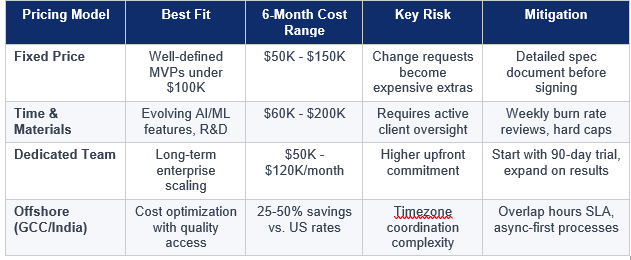
Total Cost of Ownership Components
- Usually 10% of your total project budget. Vendors who offer free discovery often make up for it by inflating development cost estimates. Discovery phase:
- Budget 20% of development costs for a dedicated QA process. Teams that mix QA into development typically ship with 40% more bugs after launch. Quality assurance:
- Plan for 15 to 20% of the original build cost every year for updates, security patches, dependency upgrades, and performance work. Annual maintenance:
- Cloud hosting, CDN, monitoring, and security tools typically add $1,500 to $8,000 per month for a mid-sized enterprise platform. Infrastructure costs:
- Moving data from legacy systems adds 15 to 30% to core development costs. This is the most commonly underestimated expense in enterprise projects. Integration and migration:
Best Practice: When you send RFPs to your top five vendors, ask for a line-by-line budget breakdown with milestone-based payment schedules and clear penalty clauses for missed delivery dates. A vendor who refuses to commit to milestone payments is showing low confidence in their own delivery ability.
6. Security, Compliance, and Scalability Verification
Cybersecurity incidents cost organizations an average of $4.5 million per breach in 2024. In heavily regulated industries, the fines from non-compliant software can be even higher. Security and compliance checks are not a nice-to-have. They are the foundation of any serious enterprise software procurement process.
Mandatory Security and Compliance Checkpoints
- SOC 2 Type II and ISO 27001 are required for enterprise software development services in 2026. Healthcare platforms need HIPAA compliance. Fintech and e-commerce platforms need PCI-DSS. Certifications:
- Check that the vendor follows OWASP Top 10 secure coding guidelines and has automated static application security testing built into the CI/CD pipeline. Secure development lifecycle:
- The vendor should run annual third-party penetration tests and provide remediation reports. Ask for the most recent summary and proof that vulnerabilities were fixed. Penetration testing:
- Enterprise security in 2026 requires zero-trust access for all development environments. Firms without MFA, least-privilege access controls, and VPN-free architecture are behind industry standards. Zero-trust architecture:
- For GCC, EU, and healthcare clients, make sure the vendor's infrastructure can meet your regional data residency requirements without requiring major architectural changes. Data residency:
Scalability Proof Points
- Ask for load test results showing the platform handling 10x peak traffic without slowing down. Auto-scaling on AWS, GCP, or Azure should be shown in a staging environment. Load testing documentation:
- For platforms targeting more than 100,000 concurrent users, verify the vendor has experience with distributed databases, sharding, and read-replica setups. Database scalability:
- With 75% of enterprise data expected to be processed at the network edge by 2026, your vendor should have hands-on Kubernetes edge deployment experience. Edge computing readiness:
7. Communication Standards and Cultural Alignment
Project Management Institute research shows that 80% of enterprise software project success comes down to communication quality. Technical skills are a baseline expectation. The real difference between vendors who deliver on time and those who do not is how they communicate when problems come up.
Communication Quality Standards
- Non-urgent queries should get a response within 24 hours. Production incidents need a 2-hour response. Any vendor who will not commit to this in writing is not ready for enterprise work. Response SLA:
- From day one, you should have access to a shared Slack or Teams channel, a Notion or Confluence space for documentation, and a Jira or Linear board for sprint tracking. Shared project tools:
- Every week you should receive a structured update showing what was completed, what is coming next, any current blockers, and actual budget spend versus forecast. Weekly status reports:
- For projects over $100K, a dedicated engagement manager separate from the project manager helps keep strategic alignment without slowing down the development team. Dedicated account management:
Timezone and Cultural Fit Evaluation
For offshore teams, timezone overlap directly affects how fast you can work together. India Standard Time vendors typically share 4 to 5 hours of overlap with Gulf Standard Time, which is enough for a morning standup. Eastern European vendors have better overlap with UK and Western European clients but usually cost 15 to 20% more than South Asian vendors.
Cultural fit goes beyond just timezone. Before signing any contract, schedule 2 to 3 video calls with the actual technical lead and project manager who will work on your project. Pay attention to their English communication, their willingness to push back on unrealistic requests, and how they think through problems under pressure. Teams that agree with everything regardless of feasibility tend to cause the worst type of failures, ones discovered at launch rather than during planning.
8. The Vendor Shortlisting and RFP Process
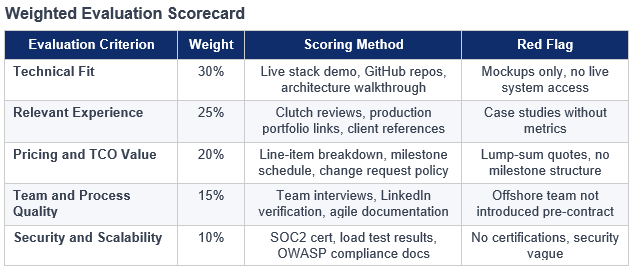
A structured vendor selection process removes the emotional and relationship biases that lead procurement teams to pick familiar names over better-fit partners. Using a weighted scoring matrix forces you to make clear tradeoffs across all evaluation areas at the same time.
Weighted Evaluation Scorecard
RFP Issuance Best Practices
- Send RFPs to your top five shortlisted vendors at the same time, right after initial screening calls.
- Ask vendors to respond within 7 to 10 business days with a detailed technical approach. A generic capabilities deck is not acceptable.
- Judge RFP responses on how specific they are. Vague answers usually mean limited domain expertise or low interest in your project.
- Run three structured interviews: one technical architecture review, one project management process walkthrough, and one team introduction session.
- Call references from at least two clients for each finalist vendor. Ask specifically how the vendor handled project problems and communication breakdowns, not only their successes.
- Sign an NDA before sharing proprietary requirements documents or giving any access to your existing codebase.
- Give your top two finalists a paid pilot task worth $5,000 to $10,000 before committing to the full project.
9. How to Build a Long-Term Vendor Partnership After You Hire a Software Development Company
Choosing the right software development company is just the first step. Businesses that get 3x to 5x more value from their software development services are the ones that build a real long-term partnership with their vendor instead of treating it like a simple transaction that ends after each delivery.
A vendor partnership is different from a vendor contract in one important way. In a contract, the vendor is responsible for delivering what was agreed. In a partnership, both sides are responsible for whether the software actually achieves the business result it was built for. This kind of shared ownership needs to be built into the relationship from the very beginning.
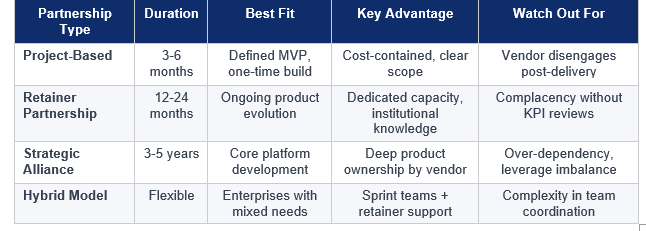
Long-Term vs. Short-Term Partnership Models
Partnership Health KPIs to Track Monthly
- Are sprint velocity numbers stable or declining? A 20% or greater drop over two consecutive sprints signals team instability or unclear requirements. Velocity consistency:
- Percentage of bugs reaching production versus caught in QA. Best-in-class software development services partners maintain defect escape rates below 5%. Defect escape rate:
- How quickly does the vendor resolve production incidents? Under four hours for critical bugs is the enterprise benchmark. Mean time to resolution (MTTR):
- Percentage of sprint commitments delivered as promised. Sustained rates below 85% indicate planning or capacity problems requiring immediate escalation. Requirement fulfillment rate:
- Track average response time to queries weekly. Degrading responsiveness is an early warning signal of team churn or account deprioritization. Communication responsiveness score:
- How many improvement suggestions, performance optimizations, or proactive risk flags has the vendor raised per quarter? High-value partners contribute ideas, not just execution. Innovation contribution rate:
Red Flags in an Ongoing Vendor Partnership
Team turnover without notice: If the vendor replaces key engineers on your project without advance discussion, institutional knowledge loss is immediate. Require 30-day notice for any senior team member change in your contract.
Scope expansion without documentation: Any work beyond the agreed sprint backlog should require a written change request with time and cost impact. Vendors who informally expand scope are setting up future invoice disputes.
Reactive-only communication: A vendor who only reports problems after they have already impacted the project is not operating as a partner. True software development services partners surface risks proactively, at least one sprint before they become blockers.
Stagnant technology practices: If your vendor has not adopted any new tools, frameworks, or processes in 12 months, they are accumulating technical debt on your behalf. Partnership contracts should include annual technology review clauses.
When to Renew, Renegotiate, or Exit a Vendor Partnership
Annual partnership reviews are one of the most underused tools in enterprise software procurement. Schedule a 60-minute review at the 6-month and 12-month marks of every engagement. Evaluate the vendor against the original KPI commitments, current market rate benchmarks, and your updated technical requirements. Use the software development company checklist from Section 11 as your re-evaluation framework, not just for initial selection but as an annual health check.
Renew when KPIs are consistently met, the team brings new ideas proactively, and rates stay within 15% of market benchmarks. Renegotiate when delivery quality is good but pricing has gone above market or the project scope has changed significantly from the original estimate. Exit when two quarterly reviews in a row show unresolved KPI failures, communication has broken down despite escalation, or the vendor no longer has the technical capability your 2026 platform needs.
When you do exit, make sure the knowledge transfer clause in your master service agreement is enforced. Require at least 30 days of parallel operation with the incoming team, complete documentation of all architecture decisions, and a code handoff that includes passing automated test suites. Any vendor that resists a structured handoff was never truly operating as your partner.
10. 2026 Technology Trends Shaping Partner Selection
The vendor you choose today needs to be able to build software that stays competitive through 2028 and beyond. Several technology shifts are changing what capabilities really matter when you evaluate a software development partner.
AI Agent Integration
AI agents that plan, write code, test, and deploy software on their own are automating around 30% of routine development tasks in 2026. Smart firms are using LangGraph, Claude, and OpenAI Codex in their development workflows to deliver projects 25 to 35% faster. When you evaluate a vendor, ask them directly how they use AI in their own work. Firms still writing all boilerplate code by hand have a real cost disadvantage compared to AI-assisted teams.
Edge Computing and On-Device AI
By 2030, there will be 50 billion IoT devices and 75% of enterprise data will be processed at the network edge rather than in central data centers. Software architecture decisions made in 2026 need to account for edge deployment from the start. A vendor without hands-on Kubernetes edge experience or on-device AI model optimization skills will cost you money in architectural rewrites as your platform grows.
Composable Architecture and Micro-Frontends
Monolithic applications are being replaced by composable architectures where frontend and backend components can be deployed independently. Vendors with micro-frontend experience and modern backend-for-frontend patterns using tools like Supabase, PlanetScale, and serverless edge functions can deliver new features 50% faster than teams still building traditional monoliths.
Sustainable Engineering and Green Cloud
65% of enterprise executives now include sustainability in their technology vendor decisions. Green cloud computing means choosing providers and building architectures that use resources efficiently and reduce carbon footprint. Vendors with real experience in carbon-aware scheduling, efficient containerization, and right-sized infrastructure are becoming a competitive differentiator for enterprise clients.
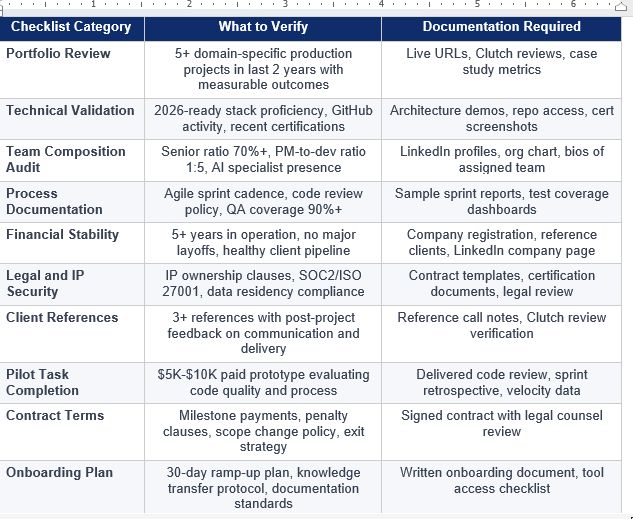
11. The Software Development Company Checklist
Use this checklist as your main framework during the entire vendor selection process. Score each item from 1 to 5 for every candidate. This gives you a clear number to compare all finalists against each other.
12. Implementation Roadmap: From Search to First Sprint
You can keep your vendor selection timeline tight without cutting corners. This roadmap works for an enterprise decision-maker who has 2 to 4 hours per week to spend on vendor management.
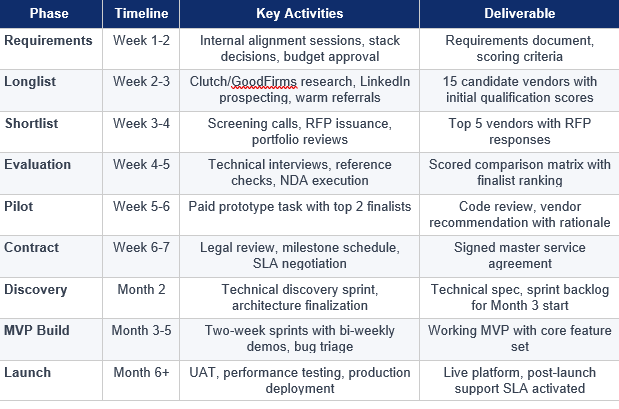
13. Critical Mistakes to Avoid When Hiring a Software Development Company
The most expensive vendor selection mistakes are also the most common. Knowing where enterprise projects fail most often helps you build the right checks before you start talking to vendors.
Choosing the lowest bid: Picking the cheapest vendor saves about 20% upfront but ends up costing 50% more in rework, timeline extensions, and emergency contractor fees within six months.
Skipping the pilot task: 45% of projects that skip a paid prototype validation end up with major quality or communication failures in the first 90 days. A $10,000 pilot can prevent a $200,000 mistake.
Underestimating security requirements: The average data breach cost $4.5 million in 2024. Vendors without SOC 2 Type II certification and OWASP-compliant development are a financial risk, not a cost saving.
Weak contract structures: Contracts without milestone payment schedules, scope change policies, and exit clauses leave you exposed to scope creep that adds an average of 30% to total project cost. Never sign a lump-sum contract for any project over $25,000.
Ignoring timezone coordination: Offshore teams without structured daily overlap hours lose about 25% of their productivity to communication delays. Require at least three overlapping business hours per day and put it in the SLA.
Frequently Asked Questions
Q: What is the average cost to hire a software development company for an enterprise project in 2026?
A: Enterprise software development projects typically cost between $50,000 for a focused MVP and $500,000 or more for full platforms with AI integration and multi-region deployment. GCC and South Asian vendors charge $25 to $60 per hour, which gives you 30 to 40% savings compared to US or Western European rates. Always look at total cost of ownership rather than hourly rate alone. Discovery, QA, maintenance, and infrastructure together add 40 to 50% on top of the raw development cost.
Q: How long does the full vendor selection and onboarding process take?
A: A proper vendor selection process takes 4 to 8 weeks from the time you finalize your requirements to signing the contract. After that, add 2 to 4 weeks for onboarding and technical discovery before the first development sprint begins. Total time from decision to first line of production code is usually 2 to 3 months. Rushing this process by even two weeks increases the chance of a major delivery failure by 35%, according to project management research.
Q: What certifications should I require for enterprise software development services?
A: The required certifications are SOC 2 Type II for data security practices, ISO 27001 for information security management, and GDPR compliance documentation for any project that handles European or international user data. Healthcare projects require HIPAA compliance. Fintech and e-commerce platforms require PCI-DSS certification. Always verify certifications through third-party audit reports, not vendor self-declarations.
Q: Fixed price versus dedicated team: which model suits an early-stage startup?
A: If your MVP scope is well defined and costs under $75,000, a fixed-price model gives you budget certainty and clear deliverable accountability. But most startups have evolving product assumptions and are better served by a dedicated team model that allows scope changes without expensive change request cycles. A common approach is to start with a fixed-price discovery and MVP phase, then move to a dedicated team model for post-launch iteration.
Q: How should I measure the ROI of a software development partnership?
A: Set KPI baselines before the project starts and measure against them at 90 days, 6 months, and 12 months after launch. The most useful metrics are time-to-market improvement (industry benchmark is 30% faster than internal development), infrastructure cost reduction (cloud-native builds typically achieve 25 to 40% savings), conversion rate improvement from better UX, and lower support ticket volume from improved reliability. Include ROI tracking as a requirement in your post-launch support agreement.
Q: Which regions offer the best combination of cost and quality for software development services in 2026?
A: GCC markets like UAE and Qatar offer strong compliance expertise and regional knowledge at rates 25 to 35% below US benchmarks. India has the largest talent pool across all technology stacks with senior developer rates of $20 to $45 per hour. Eastern Europe, especially Poland, Romania, and Ukraine, charges $50 to $80 per hour but offers excellent senior engineers with minimal timezone difference from UK and Western European clients. For GCC-specific projects that need regional compliance and Arabic language support, local or nearshore GCC vendors are often worth the small cost premium.
Q: What is the most reliable way to validate a vendor's technical claims before committing to a full engagement?
A: Use three independent verification steps together. First, run a structured technical interview with the proposed lead architect using scenario-based questions specific to your domain. Good architects talk through tradeoffs, not just final answers. Second, ask for access to a production GitHub repository from a similar completed project to review actual code quality, test coverage, and documentation. Third, give the vendor a paid pilot task worth $5,000 to $10,000 that reflects real work from your project. The pilot shows you communication patterns, code quality, and delivery reliability under actual project conditions, which no amount of portfolio review can reveal.
Conclusion: Building a 2026-Ready Software Development Partnership
Choosing a software development company in 2026 is not the same as it was five years ago. AI-assisted development, edge computing requirements, zero-trust security standards, and faster delivery expectations have all changed what a good vendor looks like. The vendor's current technical skills now matter just as much as their years of experience.
The businesses that will gain the strongest competitive advantages over the next three years are those that choose software development services partners who work as a real extension of their engineering team. These are vendors who spot architectural risks early, bring new technology ideas proactively, and care about what happens after launch just as much as they care about the initial delivery.
Use the checklist, scorecard, and implementation roadmap in this guide as your working framework. Take the 2 to 3 months of evaluation that the process deserves. Run a pilot before you commit. Write contracts with milestone accountability and clear exit terms. Track everything after launch.
The right software development company does not just build your product. They help your organization build the ability to compete in a market where software quality is the main differentiator. That partnership is worth every hour of due diligence you put into finding it.
Ready to Start Your Vendor Search?
Start with your requirements document. Shortlist 15 candidates using Clutch and LinkedIn. Send RFPs to your top five. Run a paid pilot with your top two finalists before you sign anything. Use the scorecard in Section 8 as your decision-making guide throughout the entire process.