
A technology partner can accelerate modernization, or leave your business with disconnected tools, unclear ownership, and expensive technical debt. The difference is rarely the sales pitch. It is whether the provider can prove that it understands your operating model, integrate with your real environment, and remain accountable for measurable outcomes after launch.
This guide provides a practical framework for selecting a transformation partner or strategic technology provider. It focuses on the evidence that matters most: ROI, total cost of ownership, integration capability, security, internal adoption, ownership, and exit readiness.
At a Glance
Before choosing a digital transformation company, veriy that it can:
- Translate business priorities into measurable outcomes.
- Modernize and integrate legacy, cloud, and data environments.
- Explain total cost of ownership, including hidden costs.
- Build security, compliance, and AI governance into the architecture.
- Support employee adoption and process change.
- Provide source-code ownership, documentation, and transition support.
Choose evidence over promises.
Digital Transformation Is an Operating Model Change
Digital transformation is the coordinated use of technology, data, processes, and organizational change to improve how a business creates, delivers, and captures value.
It is not limited to cloud migration, new software, mobile applications, or AI implementation. Those are technology components. The broader objective is to improve how an organization operates, serves customers, manages information, and scales new opportunities.
A program may include:
- Legacy application modernization.
- CRM, ERP, and data-platform integration.
- Workflow automation.
- Cloud or hybrid-cloud architecture.
- Customer portals and digital products.
- Enterprise analytics and reporting.
- AI models, agents, copilots, and automated decision systems.
- Cybersecurity and identity modernization.
- Employee enablement and process redesign.
A credible implementation partner should explain how these components connect to business objectives and what should be prioritized first.
Start With Outcomes, Not Tools
The first selection mistake is asking for a solution before defining the business problem.
Avoid vague requirements such as:
- “We need AI.”
- “We need cloud migration.”
- “We need digital transformation.”
- “We need a new app.”
Instead, define the result that needs to improve.
| Technology Output | Business Outcome |
|---|---|
| Build a customer portal | Reduce onboarding time and customer support demand |
| Implement an AI assistant | Improve response speed while maintaining quality controls |
| Migrate ERP workloads | Improve resilience and simplify infrastructure operations |
| Create analytics dashboards | Reduce time to identify and resolve supply-chain exceptions |
| Automate invoice processing | Reduce manual effort, errors, and payment cycle time |
A suitable technology provider should challenge vague requirements and help translate them into measurable objectives. If a provider starts recommending tools before understanding the operating problem, it may be selling capacity rather than transformation expertise.
Define ROI Before Selecting a Partner
A technology provider should connect its proposal to financial, operational, customer, and risk outcomes, not just project milestones.
Transformation ROI Formula
Transformation ROI = [(Annual Financial Benefit − Annual Transformation Cost) ÷ Annual Transformation Cost] × 100
Annual financial benefits can include:
- Verified cost savings.
- Incremental revenue.
- Productivity gains converted into financial value.
- Lower error and rework costs.
- Reduced support or infrastructure costs.
- Estimated risk avoidance.
Risk avoidance should be treated carefully. It is usually assumption-based rather than guaranteed savings. For example, reduced outage risk or fewer compliance incidents may have financial value, but the calculation should document likelihood and estimated impact.
Example: If annual benefits are $1.5 million and annual transformation costs are $1 million, the simple ROI is 50%.
A clear business case should compare net commercial value with full program cost rather than implementation expense alone.
Establish a Baseline
Measure the current state before transformation begins:
- Process cycle time.
- Cost per transaction.
- Error rate.
- Support volume.
- Customer onboarding time.
- System downtime.
- Conversion rate.
- Retention or churn.
- Compliance exceptions.
- Employee effort.
Without a baseline, a partner can claim success without evidence.
| Value Area | Example Measures |
|---|---|
| Financial | Revenue growth, cost reduction, margin improvement, cost avoidance |
| Operational | Cycle time, error rate, throughput, automation rate, downtime |
| Customer | CSAT, retention, conversion, onboarding time, first-contact resolution |
| Risk and resilience | Security incidents, audit findings, recovery time, compliance exceptions |
Use this chain to keep the program outcome-led:
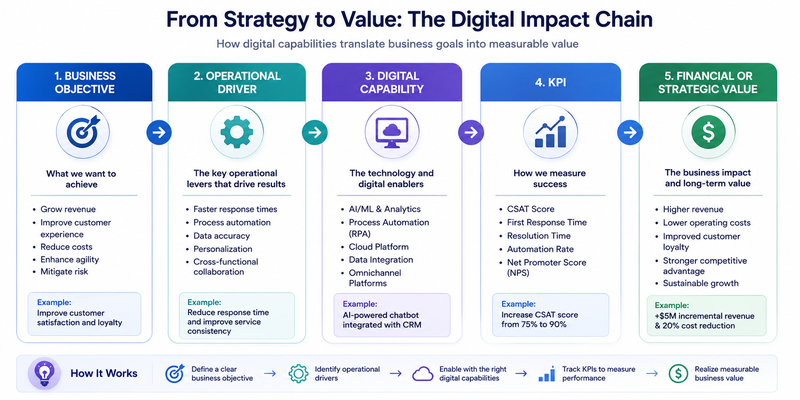
For example:
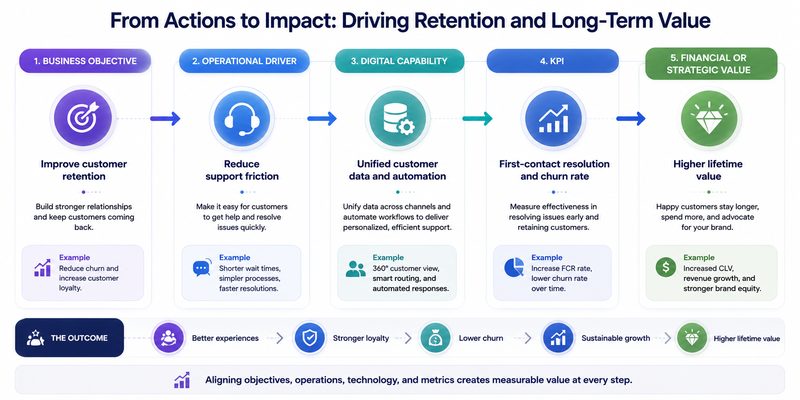
Model Total Cost of Ownership
A low implementation estimate may hide substantial long-term costs. Ask every candidate for a three-to-five-year total cost of ownership model.
Include:
- Discovery and architecture.
- Implementation and integration.
- User or device licenses.
- Cloud compute, storage, and egress.
- API consumption.
- AI model, agent, or copilot usage costs.
- Data migration and cleansing.
- Third-party integrations.
- Security testing and compliance work.
- Technical-debt remediation.
- Internal employee time.
- Training and change management.
- Vendor management.
- Maintenance, monitoring, and optimization.
- Post-contract transition and migration.
The cost of doing nothing should also be considered: slow operations, manual effort, poor customer experience, compliance exposure, and unrealized revenue opportunities.
Validate the Partner Through Discovery
For complex transformation programs, a paid discovery phase can provide more reliable evidence than a sales presentation or RFP response alone.
A focused discovery engagement may produce:
- Current-state assessment.
- Stakeholder interviews.
- System and integration inventory.
- Data-quality assessment.
- Architecture options.
- Risk register.
- Prioritized roadmap.
- KPI baseline and business case.
- Proof of concept or pilot.
- Delivery plan and TCO estimate.
The discovery scope should have defined deliverables, acceptance criteria, ownership of outputs, and a clear decision point for whether to proceed to implementation. This prevents discovery from becoming an expensive consulting phase without a practical decision framework.
Assess Integration and Modernization Capability
Many modernization programs fail because new systems do not connect safely with legacy applications, fragmented data, manual processes, and operational constraints.
Ask each provider to describe its approach to:
- API strategy and lifecycle management.
- Legacy-system modernization.
- Hybrid-cloud and multi-cloud architecture.
- Data migration and reconciliation.
- Master-data management.
- Data-quality remediation.
- Event-driven integration.
- Identity and access management.
- Observability and monitoring.
- Disaster recovery.
- Vendor portability.
A strong modernization partner should not automatically recommend “rip and replace.” In many enterprises, lower-risk modernization involves decoupling systems, introducing APIs, improving data quality, and migrating critical workloads in phases.
Meet the Actual Delivery Team
Do not choose a partner based only on proposal documents, executive presentations, or client logos.
Meet the team assigned to your work:
- Solution architect.
- Engineering lead.
- Delivery manager.
- Data architect.
- Security lead.
- Cloud or DevOps lead.
- Product or UX lead.
- Change-management lead.
Ask them to explain:
- A similar project that encountered serious constraints.
- How they managed a difficult integration.
- How they validate data quality.
- How they handle architecture trade-offs.
- How they respond to production incidents.
- How they transfer knowledge at the end of an engagement.
This conversation often reveals more than a polished case study.
Evaluate AI Governance and Security
AI is now a common component of modernization programs. However, a credible partner should demonstrate governance for AI models, agents, copilots, and automated decision systems—not just promise an AI feature.
Evaluate whether it can explain:
- What data the AI system will access.
- Where data is stored and processed.
- Whether a model provider retains or trains on business data.
- How permissions are enforced.
- How inaccurate outputs are detected and handled.
- How actions are logged for auditability.
- Which actions require human approval.
- How performance, drift, and safety are monitored.
- How workflows can be paused, rolled back, or changed.
- How the organization can change model providers later.
For AI agents that access internal systems or trigger workflows, permission boundaries, least-privilege access, audit trails, human oversight, evaluation, monitoring, and rollback mechanisms are essential.
Security should be embedded in discovery, architecture, development, deployment, and operations.
| Engagement Model | Best For | Watch Outs |
|---|---|---|
| Advisory / consulting | Strategy, assessment, roadmap design | Internal team must be capable of execution |
| Managed services | Ongoing operation of defined systems | Clarify SLAs, ownership, and escalation paths |
| Dedicated delivery team | Long-term modernization or product delivery | Avoid dependency on unnamed or rotating resources |
| Hybrid / full-spectrum | Strategy, delivery, adoption, and optimization | Requires clear decision rights and governance |
| Outcome-based | Measurable and well-defined objectives | Difficult to structure when baselines are unclear |
A hybrid model often suits large programs because it combines strategic guidance with execution capacity and post-launch optimization. However, the client should retain ownership of strategy, risk appetite, customer experience, and product decisions.
Cultural Fit and Change Management
Technology does not transform a business unless people adopt new workflows.
Evaluate cultural fit through:
- Discovery workshops.
- Joint problem-solving sessions.
- Reference calls.
- Interviews with delivery leads.
- Change-management plans.
- Training and adoption proposals.
Ask how the partner will support:
- Executive alignment.
- Stakeholder communication.
- Employee training.
- Digital skills development.
- Adoption measurement.
- Process redesign.
- Resistance management.
- Post-launch support.
A strong provider treats change management as a continuous workstream, not a presentation delivered shortly before go-live.
| Assessment Criterion | What Excellent Looks Like | Major Red Flag |
|---|---|---|
| Domain proof | Relevant delivery experience in your industry and regulatory context | Generic case studies or unrelated brand logos |
| Business alignment | Recommendations tied to measurable outcomes | Focus on tools, platforms, or features |
| Integration depth | Clear architecture for legacy, cloud, data, APIs, and monitoring | Abstract explanations with no systems-level detail |
| Delivery team | Named, experienced team with accountable senior leaders | Unclear staffing or reliance on sales personnel |
| Financial transparency | Clear TCO, assumptions, milestone gates, and change control | Low initial estimate with unclear ongoing costs |
| Security and AI governance | Built-in security, compliance, auditability, permissions, and human oversight | Security and governance treated as later phases |
| Business continuity and resilience | Defined downtime tolerance, RTO/RPO, disaster recovery, incident response, and continuity planning | No tested recovery plan or unclear operational ownership |
| Change enablement | Training, adoption metrics, and internal capability building | “Go-live” treated as the end of engagement |
| Exit readiness | IP ownership, documentation, exportability, and handover plan | Proprietary lock-in or unclear exit clauses |
How to Score Each Partner
Rate every criterion from 1 to 5:
- 1: Significant concern or limited evidence.
- 2: Below requirements.
- 3: Acceptable but requires further due diligence.
- 4: Strong evidence and good fit.
- 5: Exceptional evidence and highly relevant capability.
Weighted score = Rating × Weight
Example: A partner rated 4/5 on a criterion carrying a 20% weight receives:
4 × 0.20 = 0.80 weighted points
Add all weighted points to calculate a total score out of 5.
| Weighted Average | Interpretation |
|---|---|
| 4.0–5.0 | Strong fit; proceed to commercial and delivery validation |
| 3.0–3.9 | Potential fit; conduct further due diligence |
| Below 3.0 | High-risk candidate; reconsider or remove from shortlist |
Prevent Vendor Lock-In Through Contract Design
Vendor lock-in is not always avoidable, but it should be understood and managed before signing.
The agreement should cover:
- IP ownership: Source code, configurations, workflows, data models, and custom AI assets.
- Source-code escrow: Where appropriate, access if the provider becomes unavailable or fails to meet obligations.
- Data export: Formats, frequency, completeness, and cost of extraction.
- API and documentation access: API specifications, architecture diagrams, runbooks, and configuration records.
- Third-party licenses: Whether licenses can be transferred, retained, or replaced.
- SLA and SLO definitions: Availability, performance, support, and recovery commitments.
- Incident severity levels: Definitions for critical, high, medium, and low-priority incidents.
- Response and resolution targets: Target timelines for each severity level.
- Service credits: Commercial remedies where appropriate for repeated SLA failures.
- Responsibility matrix: A RACI model for infrastructure, security, integrations, data pipelines, monitoring, and support.
- Transition assistance: Support for handover to an internal team or new provider.
- Termination fees: Notice periods, early-exit charges, final invoices, and hosting obligations.
- Knowledge-transfer obligations: Documentation and structured handover sessions before the contract ends.
The goal is not to assume the relationship will fail. It is to preserve continuity and strategic flexibility.
What to Look for in a Digital Transformation Partner in India
When evaluating a digital transformation partner in India, use the same core criteria—outcomes, integration, security, TCO, and adoption—but assess the delivery model in context.
Consider:
- India and global delivery capability.
- GCC and enterprise experience.
- Data, privacy, and data-residency requirements.
- Multi-location delivery and time-zone coverage.
- English and business communication quality.
- Cost versus architecture and delivery capability.
- Local implementation, training, and post-launch support.
- Ability to work with distributed stakeholders and global customers.
The location or hourly rate should not replace evidence of relevant delivery experience, security maturity, technical depth, and accountable leadership.
10 Questions to Ask Every Technology Partner
- What measurable business outcome would you target first, and why?
- What assumptions are you making about our systems, data, teams, and operating model?
- What would you not modernize in the first phase, and why?
- Which integrations represent the highest delivery risk?
- Who exactly will lead architecture, engineering, data, security, and delivery?
- What is the fallback plan if the proposed architecture does not perform as expected?
- What costs are excluded from the total cost of ownership estimate?
- How will you measure user adoption and business value after go-live?
- What data, source code, configurations, documentation, and AI assets will we own?
- How would we transition the platform to an internal team or another provider if required?
A credible partner should answer these questions clearly, identify trade-offs, and explain uncertainty rather than overpromise certainty.
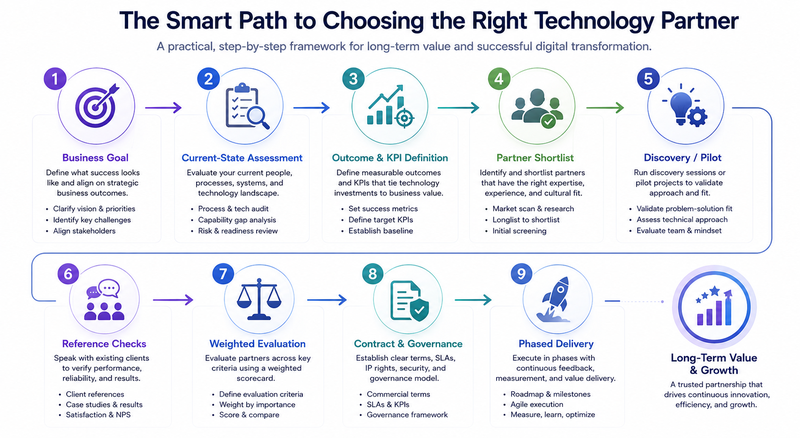
Practical Selection Process
Step 1: Define the mandate
Document the business problem, target outcomes, scope, constraints, stakeholders, budget range, and KPIs.
Step 2: Map the current environment
Inventory systems, data sources, integrations, manual workarounds, technical debt, security controls, and regulatory obligations.
Step 3: Shortlist three to five candidates
Choose candidates based on relevant domain, technical, and delivery evidence—not brand recognition alone.
Step 4: Issue a focused RFP
Ask every candidate the same questions about:
- Outcomes and KPIs.
- Architecture and integration.
- Security and AI governance.
- Team composition.
- Delivery approach.
- TCO and commercial assumptions.
- Change management.
- Ownership and exit terms.
Step 5: Run workshops or paid discovery
Evaluate collaboration, technical depth, communication, and practical problem-solving before making a large commitment.
Step 6: Conduct reference checks
Speak with two or three comparable customers.
Ask:
- Was the project delivered on time?
- Did costs change materially from the original proposal?
- How did the partner handle production issues or missed milestones?
- Was the proposed senior team actively involved?
- Did the provider provide useful documentation and knowledge transfer?
- Would you hire the partner again?
Step 7: Score consistently
Use the weighted scorecard for every candidate. Separate documented evidence from general impressions.
Step 8: Contract for accountability
Include measurable milestones, acceptance criteria, KPI reporting, security obligations, source-code ownership, documentation, knowledge transfer, change-control rules, service levels, and transition support.
Step 9: Govern, measure, and optimize
Set up executive sponsorship, decision rights, architecture governance, risk management, KPI reviews, and escalation paths.
Selection Flow
For the website, present this as a visual flowchart:
Frequently Asked Questions
What should businesses look for in a digital transformation partner?
Look for relevant industry experience, outcome alignment, integration expertise, a named delivery team, security capability, commercial transparency, change-management support, and clear ownership and exit terms.
How do you measure ROI in a transformation program?
Use a baseline and compare annual financial benefit against annual transformation cost. Benefits can include verified cost savings, incremental revenue, productivity gains, and carefully estimated risk avoidance.
Why is integration capability important?
New systems that do not connect with legacy applications, data sources, workflows, and identity controls can create additional silos. Integration capability is essential for sustainable modernization.
How many technology partners should a business shortlist?
For most complex programs, three to five qualified candidates is manageable. It provides enough comparison without overwhelming internal stakeholders or weakening due diligence.
How long does technology partner selection take?
It depends on program scope, procurement requirements, regulatory obligations, and environment complexity. A focused selection process may take weeks, while enterprise programs involving discovery, security review, workshops, and commercial negotiation can take longer.
Should companies choose a large consultancy or a specialist provider?
It depends on the program. Large consultancies may offer scale and broad capabilities, while specialists may provide stronger depth in a specific technology, industry, or delivery model. Evaluate the assigned team, delivery evidence, commercial terms, and outcome fit, not the logo alone.
What is a paid discovery phase?
A paid discovery phase is a focused engagement before a larger contract. It can include assessment, stakeholder interviews, architecture planning, integration analysis, risk identification, a roadmap, and a business case.
How can companies avoid vendor lock-in?
Define IP ownership, source-code access, exportable data formats, API and documentation access, third-party license terms, transition assistance, and knowledge-transfer obligations in the contract.
What role does change management play?
Change management ensures employees understand, adopt, and sustain new processes and systems. Without training, communication, leadership support, and adoption measurement, technically successful projects can fail to produce business value.
What questions should you ask a technology partner before signing a contract?
Ask who will actually deliver the work, what assumptions and exclusions exist in the proposal, how success will be measured, how the partner handles missed milestones or production issues, who owns the code and data, what support levels are included, and how the organization can transition away from the provider if necessary.
Conclusion
Choosing a technology partner for modernization is not about selecting the provider with the largest client list, lowest initial estimate, or most impressive presentation.
The right partner demonstrates how it will improve business outcomes, integrate with your current environment, protect data, enable internal teams, and preserve your ability to adapt or transition in the future.
Choose evidence over promises.