
Mobile applications have become one of the most important digital assets for modern businesses. From startups launching innovative platforms to enterprises digitizing operations, mobile apps now drive customer engagement, revenue generation, operational efficiency, and brand growth across almost every industry.
Whether it is healthcare, logistics, eCommerce, education, finance, or fitness, businesses are increasingly investing in mobile applications to stay competitive in today’s digital-first economy. However, while launching an app may seem straightforward from the outside, successful application development involves a highly structured process that requires planning, technical expertise, strategic execution, testing, and long-term optimization.
Many applications fail not because the idea is weak, but because businesses skip critical development stages, underestimate scalability challenges, or ignore user experience. In fact, poor planning, inadequate testing, and weak post-launch support remain some of the biggest reasons mobile apps struggle to succeed.
Understanding the app development lifecycle helps businesses reduce risks, optimize investments, and build applications that can scale successfully over time.
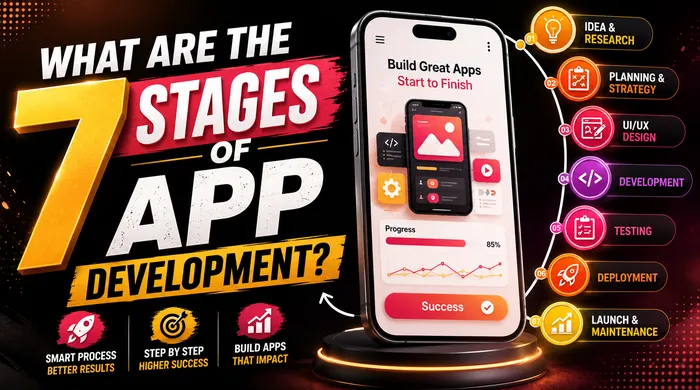
This guide explains the 7 stages of app development in detail while helping businesses understand how successful applications are built from concept to launch and beyond.
Stage 1: Discovery & Market Research
Every successful app begins with proper research and idea validation. This stage focuses on understanding the market, identifying user problems, analyzing competitors, and defining business goals before development begins.
Many businesses make the mistake of jumping directly into coding without validating whether there is actual demand for the application. This often leads to wasted investments and poor adoption rates.
The discovery phase helps businesses answer important questions such as:
- Who are the target users?
- What problems will the app solve?
- What features are truly necessary?
- Who are the competitors?
- How will the app generate revenue?
- Which platforms should be prioritized?
For example, a fitness app may require workout tracking, wearable integration, AI coaching, and nutrition management, while a logistics app may prioritize GPS tracking, route optimization, and delivery management.
This phase also includes competitor analysis. Businesses study existing applications to identify gaps, weaknesses, and opportunities that can help differentiate their own platform.
A proper market research process generally includes:
- User persona creation
- Industry trend analysis
- Feature prioritization
- Monetization strategy planning
- Technical feasibility analysis
- Customer behavior analysis
- Platform selection (Android, iOS, or both)
Modern companies increasingly use AI-powered business solutions during this phase to analyze customer behavior, forecast engagement patterns, and personalize future app experiences using real-time data insights.
The discovery stage creates the strategic foundation for the entire development lifecycle and significantly reduces long-term project risks.
Stage 2: Planning & Strategy Development
After validating the app idea, businesses move into the planning phase where strategies, workflows, and technical requirements are documented in detail.
This stage transforms ideas into structured execution plans that guide the development team throughout the project lifecycle.
Planning generally includes:
- Requirement documentation
- Workflow mapping
- User journey planning
- Technical architecture creation
- Security planning
- API structure planning
- Database planning
- Scalability analysis
One of the most important decisions during this phase is selecting the right development approach.
Businesses usually choose between:
Development Approach
Description
Native Development
Separate apps for Android and iOS
Cross-Platform Development
Single codebase for multiple platforms
Hybrid Development
Combination of web and mobile technologies
Cross-platform frameworks such as Flutter and React Native are increasingly popular because they reduce development costs while maintaining consistent user experiences across devices.
Another major focus during planning is defining the Minimum Viable Product (MVP).
An MVP contains only the essential features required for launch. Instead of investing heavily in every possible feature initially, businesses launch a smaller version first and improve the product gradually using customer feedback.
This approach helps businesses:
- Reduce initial investment risks
- Accelerate launch timelines
- Validate market demand faster
- Improve product-market fit
- Collect real-world user feedback early
A well-planned development roadmap improves project clarity and helps teams avoid costly delays during development.
Stage 3: UI/UX Design
UI/UX design is one of the most important stages of app development because it directly affects customer satisfaction, user engagement, and retention rates.
Users often decide within seconds whether they like an application. Even highly functional apps fail if navigation feels confusing or the interface appears outdated.
UI (User Interface) focuses on visual design, while UX (User Experience) focuses on usability and interaction quality.
During this stage, designers create:
- Wireframes
- User flows
- Interactive prototypes
- Screen layouts
- Navigation structures
- Design systems
The primary goal is to create intuitive, smooth, and visually engaging user experiences.
Effective UI/UX design focuses on:
- Simplicity
- Responsive layouts
- Accessibility optimization
- Fast-loading interfaces
- Consistent branding
- Easy navigation
- Personalized experiences
Modern applications increasingly use animations, gesture controls, and micro-interactions to improve engagement and create smoother user journeys.
For example:
- eCommerce apps simplify checkout flows
- Healthcare apps streamline appointment booking
- Banking apps prioritize secure interactions
- Fitness apps emphasize progress visualization and motivation
Businesses investing in custom mobile app development strategies often prioritize user experience heavily because even small usability improvements can dramatically improve customer retention and app store ratings.
A great user experience has become a major competitive advantage in today’s crowded app ecosystem.
Stage 4: App Development
The development phase is where designers’ concepts and business strategies are transformed into functional applications through coding and technical implementation.
This stage is generally divided into frontend and backend development.
Frontend Development
Frontend development focuses on everything users interact with directly.
This includes:
- User interfaces
- Navigation systems
- Buttons and forms
- Dashboards
- Interactive elements
- Animations
- Responsive layouts
Frontend developers ensure the app remains visually consistent and performs smoothly across different devices and screen sizes.
Backend Development
Backend development powers the operational functionality of the application.
This includes:
- Databases
- APIs
- Authentication systems
- Cloud infrastructure
- User management
- Payment systems
- Notifications
- Data synchronization
Backend systems are critical because they determine scalability, speed, reliability, and security.
Modern mobile applications increasingly rely on cloud-based infrastructure because it provides:
- High scalability
- Real-time synchronization
- Secure data storage
- Faster performance
- Remote accessibility
- Load balancing
Applications involving video streaming, AI recommendations, wearable integrations, GPS tracking, or social networking require especially strong backend architecture because they process massive amounts of data continuously.
Businesses also integrate multiple third-party services during development such as:
- Payment gateways
- GPS systems
- SMS services
- Push notifications
- Analytics platforms
- Wearable integrations
- Video APIs
Development teams commonly use Agile methodologies, dividing projects into smaller sprint cycles that allow continuous improvements, testing, and faster feedback implementation throughout the process.
Backend Infrastructure and Scalability in Modern App Development
One of the most overlooked areas of app development is backend scalability planning. Many businesses focus heavily on frontend design while underestimating how important infrastructure is for long-term app performance.
The backend acts as the operational engine of the application. It processes user requests, stores data, manages APIs, handles authentication, and supports all application functionality behind the scenes.
A fitness app with only a few hundred users may function perfectly on basic infrastructure. However, once the platform scales to thousands or millions of users, weak backend systems can create serious problems such as:
- Slow loading speeds
- Server crashes
- Failed transactions
- Data synchronization issues
- Poor user experiences
Modern applications increasingly use cloud-native infrastructure because it allows businesses to scale resources dynamically as traffic grows.
Businesses also prioritize microservices architecture, where individual services such as notifications, chat systems, payment processing, and analytics operate independently while remaining connected within the same platform.
This approach improves:
- Scalability
- System flexibility
- Maintenance efficiency
- Performance optimization
- Long-term development costs
Strong backend planning ensures applications remain stable and future-ready as business growth accelerates.
Stage 5: Testing & Quality Assurance
Testing ensures the application performs correctly under real-world conditions before launch.
Many businesses underestimate the importance of quality assurance, but even small bugs can damage customer trust, app ratings, and business reputation.
Testing focuses on identifying issues related to:
- Functionality
- Security
- Compatibility
- Performance
- User experience
- Load handling
- Device responsiveness
The testing process generally includes:
Testing Type
Purpose
Functional Testing
Ensures features work properly
Performance Testing
Measures app speed and stability
Security Testing
Identifies vulnerabilities
Compatibility Testing
Tests multiple devices and OS versions
Load Testing
Evaluates performance under traffic
Usability Testing
Analyzes user experience quality
Applications must work smoothly across different smartphones, operating systems, and screen sizes.
For example, an app optimized only for flagship devices may perform poorly on low-end smartphones if testing is inadequate.
Quality assurance teams also test:
- Payment systems
- Login functionality
- Notifications
- API communication
- Offline functionality
- Data synchronization
Proper testing significantly reduces launch risks and improves long-term application reliability.
Common App Development Mistakes Businesses Should Avoid
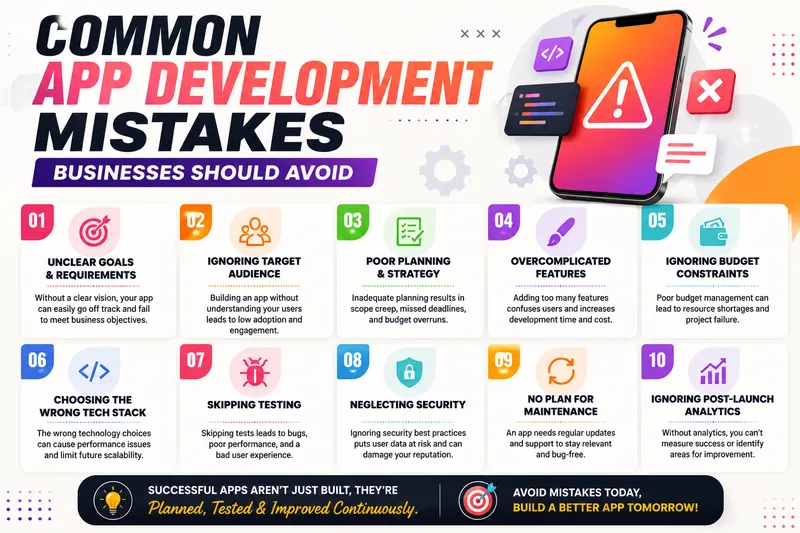
Many businesses make strategic mistakes during app development that create major long-term challenges.
One common mistake is attempting to launch too many features initially. Overloaded applications increase complexity, delay launch timelines, and create confusing user experiences.
Another major issue is ignoring scalability during the early development stages. Applications designed for small user bases may struggle badly once traffic increases if backend systems are not properly planned.
Other common mistakes include:
- Weak security implementation
- Poor testing processes
- Inexperienced development teams
- Lack of post-launch planning
- Poor UI/UX decisions
- Ignoring customer feedback
- Underestimating maintenance costs
Businesses should understand that app development is not a one-time project. Continuous updates, feature improvements, security patches, and optimization are necessary for long-term success.
Working with experienced development teams significantly reduces technical and operational risks throughout the development lifecycle.
Stage 6: Deployment & Launch
After testing is completed, the application is prepared for public release.
Deployment involves:
- Production server setup
- Security verification
- Performance monitoring setup
- Final optimization
- App store preparation
Applications are then submitted to:
- Google Play Store
- Apple App Store
However, launching an app involves far more than simply uploading files.
Both app stores have strict approval requirements covering:
- Privacy policies
- User safety
- Performance standards
- Data handling compliance
- Content guidelines
Businesses also prepare marketing campaigns before launch to maximize visibility and downloads.
These strategies often include:
- Social media marketing
- Paid advertisements
- Influencer collaborations
- PR campaigns
- SEO optimization
- Email marketing
A strong launch strategy significantly affects early user acquisition and long-term app growth.
The Role of App Store Optimization (ASO) in App Success
App visibility is one of the biggest challenges businesses face after launch.
Millions of applications compete for user attention on both the Apple App Store and Google Play Store. Without proper App Store Optimization (ASO), even high-quality applications may struggle to attract downloads.
ASO focuses on improving app discoverability through:
- Keyword optimization
- App title optimization
- Screenshot design
- Video previews
- Ratings and reviews
- Description writing
- Retention optimization
For example, fitness apps may target keywords related to:
- Workout tracking
- Home workouts
- Calorie counting
- Weight loss
while fintech apps may focus on:
- Budget management
- Mobile banking
- Digital payments
Attractive screenshots and preview videos also improve conversion rates by helping users understand the app experience before downloading.
Successful app growth depends heavily on both technical development and strategic app marketing.
Stage 7: Maintenance & Continuous Improvement
App development does not end after launch.
Post-launch maintenance is one of the longest and most important stages because applications require continuous updates to remain secure, stable, and competitive.
Maintenance activities include:
- Bug fixes
- Security updates
- Performance optimization
- Feature enhancements
- Infrastructure monitoring
- API upgrades
- OS compatibility updates
User feedback collected after launch helps businesses improve app experiences continuously.
Modern applications evolve rapidly based on:
- User behavior analytics
- Industry trends
- Competitor innovations
- Technological advancements
For example:
- Fitness apps may later integrate AI coaching
- Healthcare apps may add telemedicine features
- eCommerce apps may implement AR shopping experiences
Regular updates improve:
- Customer retention
- App store rankings
- Revenue generation
- User engagement
- Brand reputation
Long-term app success depends heavily on continuous innovation and optimization.
How Emerging Technologies Are Transforming Mobile Applications
The mobile app industry continues evolving rapidly as emerging technologies reshape digital experiences.
Artificial intelligence has become one of the most significant transformations in modern app development.
AI-powered applications now support:
- Personalized recommendations
- Intelligent automation
- Predictive analytics
- Voice assistants
- Real-time customer support
Machine learning algorithms continuously improve user experiences using behavioral data and interaction patterns.
Other technologies transforming mobile applications include:
Technology
Impact
Artificial Intelligence
Personalization and automation
Blockchain
Enhanced security and transparency
IoT
Real-time device communication
AR/VR
Immersive experiences
5G Connectivity
Faster app performance
Cloud Computing
Scalable infrastructure
Businesses investing in emerging technologies early often gain strong competitive advantages because users increasingly expect intelligent, seamless, and personalized digital experiences.
How Businesses Can Choose the Right App Development Partner
Selecting the right development company is one of the most important decisions in the entire app development journey.
Many businesses choose vendors based only on pricing, but low-cost development often leads to poor code quality, missed deadlines, scalability issues, and expensive redevelopment later.
Businesses should evaluate development partners based on:
Technical Expertise
Strong development companies should have experience with:
- Native development
- Cross-platform frameworks
- Cloud infrastructure
- API integrations
- Scalable backend systems
- Security implementation
Industry Experience
Industry-specific expertise helps developers understand operational challenges more effectively.
For example:
- Healthcare apps require compliance knowledge
- Logistics apps require GPS integrations
- Fitness apps require wearable synchronization
Post-Launch Support
Reliable maintenance and support are critical for long-term application success.
Businesses require ongoing assistance for:
- Feature updates
- Bug fixes
- Performance optimization
- Infrastructure scaling
- Security patches
Choosing the right technology partner significantly improves project success rates while reducing operational and technical risks.
Conclusion
Understanding the 7 stages of app development is essential for businesses planning successful digital products. From market research and strategic planning to design, development, testing, deployment, and long-term maintenance, every stage plays a critical role in building scalable and high-performing applications.
Modern mobile applications are no longer simple digital tools. They are powerful business assets capable of improving customer engagement, streamlining operations, increasing revenue, and strengthening brand positioning in competitive markets.
Businesses that invest in structured development processes, scalable technologies, strong user experiences, and continuous optimization are far more likely to achieve long-term success in today’s mobile-first economy.
Whether building a startup MVP or an enterprise-level platform, working with experienced development professionals ensures better scalability, improved security, smoother execution, and stronger long-term performance.
As technology continues evolving rapidly, companies that prioritize innovation and high-quality app development will remain ahead in the increasingly competitive digital landscape.